

Atlantis Solar


Tel: 916-226-9183 | Save Paper Use PDF: | Email: sales@atlantissolar.com
®
Every one is plugging in! “Go Green”
®


Producing energy from heat:
Heat Transfer. The Never Ending Destiny
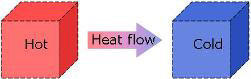
Heat transfer, or heat exchange, is a process of (what some people nickname it as) "heat migration" from a point, to
another point.
Come again? From what point to what point?
From a point of higher temperature to a point of lower temperature.
Tell me about heat transfer from the beginning, please.
What if, I start at energy?
Energy, as defined by my Physics teacher, Mr Ismail, back in high school, is the ability to do work.
Work, in simple terms, is defined as force (F) applied to move any object, by a distance (x).
Hence, if the force required to move the object is larger, i.e. moving a train (due to its steel-laden weight), then the work done per distance moved is
much larger than moving a bag of cotton.
That was just an example.
The indestructible nature of energy:
As explained in the compression section, every atom has an internal energy.
This is due to the continuous motion of electron/s orbiting the neutron/s and proton/s. Electron has its own mass to move, so force is required. Electron
has its own distance to move. Hence, energy is existent.
As long as the basic of all building blocks, namely electron, proton, and neutron exist, energy can neither be destroyed nor created.
Therefore, energy can only be transformed from one state, to another:
Consider a sample of gas, with a specified internal energy.
Consider another sample of gas with lower internal energy.
Now, due to the internal energy from the electrons, atoms or molecules will move in a specified random motion. Speed of which these particles (atoms or
molecules) move, will depend on the internal energy. The higher its internal energy, the higher the speed of these particles.
Back to our samples of gas.
When these gases are brought into contact, the gas particles will start to collide with each other. Gas particles with higher internal energy, will collide with
gas particles with lower internal energy.
Speed of these particles will be traded. The lower particles’ speed will gain its speed, and the higher gas particles’ speed will loose its speed.
Analogy
It is analogous to what happens when a white ball in snooker game hits a pack of snooker balls. Initially, the white ball will have a very high speed. As it
impacts the pack of balls (which are initially at a standstill), the white ball will loose its speed tremendously, and the rest of the pack will gain some
speed.
This is an example of how energy is transferred from one state, to another.
So, how can you say that heat is a form of energy?
A specific sample of gas, with temperature above 0 Kelvin, and a finite mass; has particles vibrating, rotating, or travelling at a high speed. In other
words, these particles are moving.
Since these particles are in motion, the gas particles are doing work! Therefore, heat is a form of energy.
Change gas to liquid giving you cold :
Manufacturers of air conditioners use refrigerants, since it has an attractive boiling temperature for heat exchange between air that we live in, and the
refrigerant.
But, our atmospheric condition will not allow refrigerant to be in liquid state. Hence, we need to compress it enough, coupled with condensing it, to
change the state from gas, to liquid. The energy from compression and condensation overcomes the internal energy of the refrigerant. Hence the state is
changed from gas to liquid through compression and condensation.
This stage is coupled with compression, for two reasons,
•
to change the refrigerant’s state from high pressure gas to high pressure liquid
•
to avoid having very large compressor to compress refrigerant beyond critical point – i.e. change gas to liquid without going through liquid-vapour
phase. In other words, ensuring air conditioners are designed properly
Sneak peek into the basics:
Every atom and molecule of matters has a specific internal energy, as explained in compression page. And due to this specific internal energy, different
matter exists in different state (solid, liquid, or vapour) at a given pressure and temperature.
Solids will have atoms or molecules packed together very closely, hence the movement only involves rotation about each atom or molecule’s axis.
Liquid however, will have a close formation of molecules or atoms. The movement is much more flexible than solids, but still restricted to short distances.
Liquid has higher molecule or atomic energy compared to solid, but lower energy compared to vapour.
Vapour has all the freedom in this world, to move in all direction possible, with large distances between each atoms or molecules, high speed and random
in motion. It has the highest molecule or atomic energy between solid and liquid.
Our interest is in vapour and liquid phases, and the phase in between. The phase in between? Keep reading.
Condensation wishes to introduce itself:
Condensation is defined as the state, when a vapour starts to change phase into liquid state, as a result of temperature drop.
It starts when a superheated vapour reaches its saturation point.
We have to bear in mind that condensation does not occur at a singular temperature. It occurs at different ranges of temperature. Reason being, the
pressure of the vapour itself.
Compression page has explained that increasing the pressure will reduce the distance between the vapour molecules. Thus, vapour molecules will have
lower net energy.
Decreasing the pressure will have a reverse effect, where the distance between the molecules will increase, and net molecular energy will increase.
So, if a gas or vapour has a higher net energy, more energy needs to be removed to reduce the distance between the molecules.
Similarly, lower net energy of vapour requires less energy removal for molecules distance to close.
What’s with all the molecule distance and energy removal?
As explained earlier, the molecule distance is a characteristic to different states of a matter. Solid, liquid, or vapour.
Energy can be in terms of work, or heat. And when condensation is in the picture, energy removal is in terms of heat.
Hence, as the pressure of the vapour increases, the heat removal required is smaller to condense it. This means that condensation of the matter starts to
happen at a higher saturation (or boiling) temperature. This is good, as any temperature lower than the saturation temperature, means we will have a
condensed liquid.
The flip side occurs for low vapour pressure.
Let us consider Refrigerant 12 as an example.
Referring to Rogers’ and Mayhew’s “Thermodynamic and Transport Properties of Fluids”:
the saturation temperature at 1 bar is about -30 oC (-22 oF)
whereas the saturation temperature at 9.6 bar is about 40 oC (104 oF)
This means that we have to have ambient air at -30 oC (-22 oF) for condensation of the refrigerant to occur at ambient pressure.
Well, if we have that kind of ambient temperature, we wouldn’t need cooling anymore don’t we?
You see, the ambient temperature for the compressed refrigerant does not have to be very low for condensation to occur. In fact the saturation
temperature is higher than most ambient temperatures during hot summer. Hence heat exchange occurs from the refrigerant, to ambient air.
This is why we have to couple condensation with compression in air conditioner systems.
Bring the pressure up, close the gap between the gases, and remove the heat from the refrigerant to close the gap even more – liquid refrigerant we have!
Short meeting with vapour and liquid, and the phase in between:
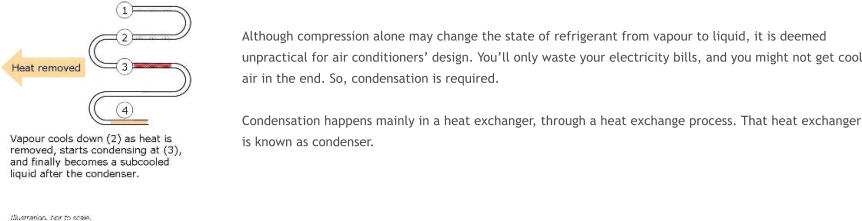
This meeting occurs when heat is continually removed from it.
If all of the matter is in vapour form, then we call it superheated vapour, as there is no condensation.
Once the temperature drops to saturation line, we will have a mix of vapour and liquid. This, is the phase in between.
Temperature will not decrease until all vapour within an enclosed space, turn into liquid.
Once in liquid form, temperature will start to decrease again, until it meets freezing point. But that’s a different story.
Condensation wishes to conclude with real life example:
Order a glass of iced lemon tea
Watch condensation of water vapour happening on the glass


Every one is plugging in ! ®
Copyright 2003-2017 © Atlantis Solar®, All rights reserved.






















