
Atlantis Solar


Tel: 916-226-9183 | Save Paper Use PDF: | Email: sales@atlantissolar.com
®
Every one is plugging in! “Go Green”
®


DO WE RECEIVE OUR MINERALS FROM DRINKING WATER?
Minerals are essential for the basic functions of the human body to take place. They help to control bone growth, regulate fluids, normalize nerve and
muscle functions, keep up metabolism, grow connective tissues, and so much more.
However, a big misconception is that that we obtain minerals from our drinking water. This is actually not true because, in reality, the main source of
minerals is always from our food and diets, not from our drinking water. Because in order to receive enough minerals for our body, we need to drink a
bathtub amount of water everyday! Not very feasible. We are sure that your doctor will not prescribe you a "bathtub of water" if you are deficient in
minerals, right?
Therefore watch out for the water products which claims that they can take out ALL of the bad contaminants and leave you only the good stuff (healthy
minerals) in the water. There is no real purification method that can be selective and leave you only the "good" stuff. When filters leave you the "good"
stuff, they actually leave you "most" of the stuff in the water. "Most of the stuff" meaning besides calcium and magnesium, they also leave fluoride,
arsenic, hard metals, radioactive materials, bacteria, viruses, chemicals, and pharmaceutical drugs. Let us not forget the fact that many natural
minerals found in water are actually toxic and radioactive in nature and are known to cause cancer. In this era of pollution where water contains much
more disease-causing contaminants than beneficial minerals, it makes sense that the water we drink should be as pure and clean as possible.
So remember to eat healthy and enjoy a variety of vegetables and grains everyday which will provide you with the beneficial organic minerals to stay
healthy the natural way.
~~~~~~~~~~~~~~~~~~~~~~~~~~~~~~~~~~~~~~~~~~~~~~~~~~~~~~~~~~~~~~~~~~~~~~
Water contains only inorganic minerals which can actually be detrimental to human health. Our bodies have a hard time processing inorganic minerals
and what we cannot absorb will be stored in our tissues and become toxic. The primary culprits are calcium salts and over time they can cause
gallstones, kidney stones, bone & joint calcification, arthritis, and hardening and blocking our arteries.
For your reference, below are the most common minerals which can be found both organically in our food supply and inorganically in natural water
sources.
Magnesium
Magnesium controls muscle contraction, protein metabolism, blood coagulation, and energy production, among other vital tasks. Failure to take in
enough magnesium over time leads to high blood pressure and osteoporosis.
That said, not only does this mineral aid in body functions, it can also help prevent disease. Studies show that magnesium in drinking water protects
against the deaths of patients with diabetes mellitus, and prevents the development of cerebrovascular disease. Magnesium also lowers the risk of
fatality from acute myocardial infarction (heart disease), particularly in females. In high-risk patients, magnesium is recommended to protect against
gastric cancer.
Calcium
Adults should consume 1000-1200 mg of calcium per day. The human body needs calcium to develop strong teeth and bones. With that, calcium can
combat osteoporosis and other bone disorders. It also helps in regulating nerve transmission, blood coagulation, and muscle contraction.
Sodium
Sodium naturally occurs in water supplies in varying amounts due to underground salt deposits and sea water. It is also added to water supplies in some
areas to make it "soft" (or through home water softeners), and used for water purification in the form of sodium hypochlorite.
Necessary for transporting nutrients throughout the body and balancing fluid levels, sodium is best known for its negative effects—namely raising blood
pressure. So, those with high blood pressure may want to avoid water with high levels of sodium. However, in moderate amounts (under 3000 mg daily),
sodium is perfectly safe.
Fluoride
There has been some controversy about fluoride being added to our water, more can be read about this debate here.
While not absolutely necessary, fluoride is proven to protect against cavities when consumed in moderate amounts (under 4 mg/L). Fluoride is partially
responsible for the rapid decline in tooth decay seen in the United States since the mid-1980s.
Special care should be taken when fluoride is ingested by children—levels over 2 mg/L can damage developing adult teeth before they break through
the gums.
Most water systems add fluoride to their water supplies, but not all; check with your local provider for additive levels in your area.
According to recent news and reports, most tap and well water in the U.S. are not safe for drinking due to heavy industrial and environmental
pollution. Toxic bacteria, chemicals and heavy metals routinely penetrate and pollute our natural water sources making people sick while exposing
them to long term health consequences such as liver damage, cancer and other serious conditions. We have reached the point where all sources of our
drinking water, including municipal water systems, wells, lakes, rivers, and even glaciers, contain some level of contamination. Even some brands of
bottled water have been found to contain high levels of contaminants in addition to plastics chemical leaching from the bottle.
A good water filtration system installed in your home is the only way to proactively monitor and ensure the quality and safety of your drinking water.
Reverse osmosis water purification systems can remove 90-99% of all contaminants from city and well water to deliver healthy drinking water for you
and your family
In August 1989 , the Almaden Times carried an article by the undersigned entitled "Bottled Drinking Water---What the Labels Mean". Dozens of
individuals visited or called and thanked us for this timely information.
Last month, Dr. Moller-Racke of the Mendocino Beverage Company posted a letter to the editor expressing his displeasure at our descriptions of the
different types of bottled and mineral waters.
Our article was technically accurate in all regards. But, it always amazes me when individuals such as Dr. Moller-Racke complain when such facts reach
the public's reading tables and popular consumer products become subjected to closer scrutiny.
Mineral water such as that marketed by Moller-Racke and dozens of others around the country is a multi-million dollar business. Simultaneously, it has
fostered controversy in the health and nutritional fields for decades.
Many individuals(mostly the bottlers) extol the curative and nutritional values of mineral water. Others (mostly nutritionists and internal medicine
specialists) caution against the drinking of such water.
The California Department of Consumer Affairs, when carefully surveying the problems with the state's drinking water systems a few years ago, went on
record stating that
"Highly mineralized water is associated with the formation of (kidney) stones in the urinary system".
The noted medical pioneer Dr. Charles Mayo(of Mayo Clinic fame), has stated that
"Water hardness(excessive minerals) is the underlying cause of many, if not all, of the diseases resulting from poisons in the intestinal tract."
Certainly Dr. Mayo, who had no monetary interest in water products of any nature---but who had considerable experience with internal medicine---
would not point accusatory fingers at mineralized drinking water unless he had not personally seen the trauma, physiological disorders, suffering and
illnesses which were caused by such materials.
On the other hand, scores of studies have underscored the importance of mineral-free drinking water which life-extension specialists have determined
has been a major factor in longevity. The Hunza people in the remote Himalayas are a classic example of individuals living well beyond one hundred
years of age using water so pure it resembles single-distilled water.
Those who have traveled to Europe and the Mediterranean encounter a near universal consumption of bottled and mineralized water. The drinking
water quality in that area of the world rates very poorly and the use of readily available, heavily mineralized water(and wines) was fostered more by
necessity than of habit or affluence.
The minerals in high-priced mineral waters (domestic or imported) are chemically no different than those which are found by elementary analysis of
soil (dirt) samples
If you like the taste of the water---that's great. Just remember that you are drinking water mixed with copious amounts of dissolved dirt, stone and
rocks---and that's it!
We need minerals to maintain a proper balance of electrolytes in our body fluids---but we need minerals which our body can easily metabolize. Would
you rather obtain calcium from natural sources such as milk, butter, cheese and other dairy products--or try to obtain it from sucking on a piece of lime
(same as calcium bicarbonate in water)?


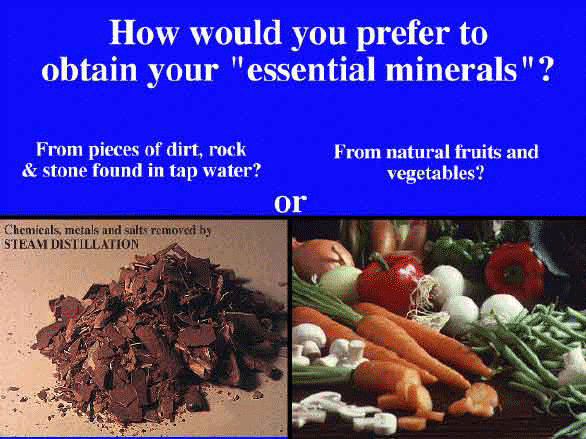
How about iron(rust in water versus natural iron in spinach)? And the list goes on and on.
Just imagine all the money your wife could save by not buying expensive fruits and vegetables for the family dining table. If we believed what the mineral
water people tell us about the nutritional value of highly mineralized water, one could get terrific nutrition by pouring a few ounces of California adobe
(dirt) and ground up rocks over their family's foods.
The human body can tell us which minerals, liquids, foods or other materials it will accept, and those which it recognizes as alien or foreign matter--and
thus proceeds to reject.
The pathological character of inorganic minerals such as those found in highly mineralized water is easily demonstrable. Take your white corpuscle(blood
cell) count about six hours after you've last had any food or water. It should be about 6,000 per milliliter.
Then, drink a normal glass of hard, mineral water. The white blood cell count will shoot up until it often more than doubles!
Inorganic chemistry doesn't lie.
This phenomena is called Leucocytosis and is our body's defense mechanism responding(via an increased white cell count) to an invading organism, germ,
infection or foreign material. When pure water, fruits, vegetables and other naturally-grown materials are eaten, the white blood cell count stays level.
However, when materials such as processed or junk foods, and heavily mineralized drinking water are consumed, the body's defense mechanism springs into
action, increasing the white blood cell count which prepares the body to do battle with and subsequently dispose of or dispense with the unwanted
"invader"---in the present case, heavy doses of inorganic salts and minerals from drinking water.
Water is a cleansing agent, foods are nutrients. Dr. Moller-Racke's statement that "water is probably our most valuable nutrient" is therefore complete
nonsense as any fourth grade life science textbook tells us. Water is our most valuable cleansing agent, flushing toxins and byproducts of metabolism from
our body while furnishing pure hydrogen and oxygen to cells and tissue.
Water is a cleansing agent, foods are nutrients. Dr. Moller-Racke's statement that "water is probably our most valuable nutrient" is therefore complete
nonsense as any fourth grade life science textbook tells us. Water is our most valuable cleansing agent, flushing toxins and byproducts of metabolism from
our body while furnishing pure hydrogen and oxygen to cells and tissue.
The cleansing attributes of pure water are impaired when it contains large doses of dissolved dirt and stone(mineral water)---and the body organs which
must eliminate these unwanted materials are continually stressed and unnecessarily overworked.
Many individuals who experience a "rush" when they drink mineral water probably misinterpret this apparent therapeutic feeling as simply the body organs
(skin, kidneys, lungs, intestines) working overtime to eliminate excess minerals which the body cannot use.
Health spas the world over rely on heavy use of mineral water(baths and drinks) to kick the patient's eliminative organs into high gear, thus providing the
exhilarating feeling when the body organs and skin begin working hard at eliminating unwanted materials(excess minerals in this case).
If mineral water really had the nutrient value that mineral water advocates claim, they would have magically solved the world's massive hunger and
nutrition problems. Let's just ship starving people mineral water or just cans and bags of dirt and ground up stone and rocks!
Even the American Medical Journal states that:
"The body's need for minerals is largely met through foods, not drinking water".
Is mineral water good for you? The evidence clearly shows that there is no benefit---and there may be some adverse effects. Your body needs pure water---
steam distilled water is the purest you can buy or make at home.

Copyright 2003-2018 © Atlantis Solar®, All rights reserved.
Every one is plugging in ! ®